Small
wooded bay area canyons shelter more than birds, wild skunks,
raccoons, and deer. They also are generally passed over for development as cities grow. Developers reluctant to build on steep rocky terrain focus their attention elsewhere, and often agencies and towns purchase the land
and preserve it for primitive recreational use. Thus we have canyons of
open space in suburban and urban areas, such as Mills Canyon in Burlingame, Big Canyon in San Carlos,
Glen Canyon in San Francisco, and Water Dog Lake Park in Belmont.
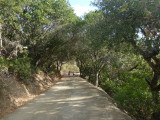
Water Dog Lake is a wooded canyon with an obstructed stream, once dammed to provide domestic water to Belmont. The open space is now comprised of two wide fire roads descending from Hallmark Drive toward the lake, a path around the lake, and a connector from the lake to fire roads. The open space is part of a little-known (except to locals) Belmont trail system. Most visitors are runners, dog walkers, and cyclists.
Since parking near Water Dog is always described
as "limited," on my first visit I figured that starting from the vista point exit on Interstate 280 was the easiest and most scenic way to get to Water Dog,
 until I tried it. I got a parking ticket (you can't park anywhere except
at the vista point lot), and although Sheep Camp Trail was nice, the easement
path down to Water Dog rates pretty high on my creepy index. Better to
park closer to Water Dog, where parking isn't all that limited (I consider
limited parking room for 3 cars; there's a lot more parking than that
here).
until I tried it. I got a parking ticket (you can't park anywhere except
at the vista point lot), and although Sheep Camp Trail was nice, the easement
path down to Water Dog rates pretty high on my creepy index. Better to
park closer to Water Dog, where parking isn't all that limited (I consider
limited parking room for 3 cars; there's a lot more parking than that
here).
Start at the gate at the end of Lake
Road. The wide fire road splits almost immediately. Bear left onto Lake Road Trail.
Poison oak is prominent, and you might
also see buckwheat and clematis (both conspicuous in summer), along with
California sagebrush, toyon, sticky monkeyflower, coyote brush, and honeysuckle.
You may also notice plants usually found in "wilderness" locations,
such as bush lupine, pitcher sage, and hollyleaf cherry. There are nice
views east out of the canyon, and on a clear day you may see across the
bay. As you descend on the gently graded road, trailside vegetation shifts
to tree cover from coast live oak, California bay, elderberry, and buckeye.
Some rough paths and steps lead left and uphill to houses on the canyon
rim. Wood rat nests are common, with some right on the edge of the trail.
To the right, look for a glimpse of the lake. At about 0.8 mile, a
 trail breaks off to the right at a signed junction. Turn right.
After a few steps downhill, you'll reach
the lake (a man-made reservoir really). Broom and yellow star thistle,
two invasive plants, are common. A path breaks off to the right of the lake, an optional add-on (not described here).
Continue to the left and at the far edge of the lake head uphill on Water Dog Loop Trail.
The narrow path climbs under coast live oaks, quickly reaching a signed junction at 0.9 mile.
Turn left onto Berry Trail.
Shade from coast live oaks is welcome on a sunny day, as the path climbs, somewhat steeply in short
stretches. An unusual bridge routes the trail over a drainage pipe. At 1.1 miles, Berry Trail crests at an unsigned junction.
Turn right onto John Brooks Trail.
Somewhere between a fire road and footpath, John Brooks Trail runs slightly downslope of a ridgeline
residential development. Along the length of the trail many paths depart to the left; ignore them all. You'll find little shade here,
although the sides of the trail are stuffed with coast live oak, toyon, some buckeye, coyote brush, ceanothus, poison oak, and holly leaf cherry.
Savor nice views across the canyon to the north as you follow the trail up and down hills. In spring, look for wildflowers in the grassy
patches; blooms persist all the way into autumn, when buckwheat puts on a final show. Around the same time coast live oak acorns litter
the path, toyon berries blush red, and honeysuckle berries drip from trailside shrubs. At 1.9 miles you'll return to the junction
with Lake Road Trail. Turn left and retrace your steps back to the trailhead.
Total distance: about 1.9 miles
Last hiked: October 16, 2015
Previous visit: June 13, 2001